You can read more and follow David Bethoney’s newsletter at The Revive.
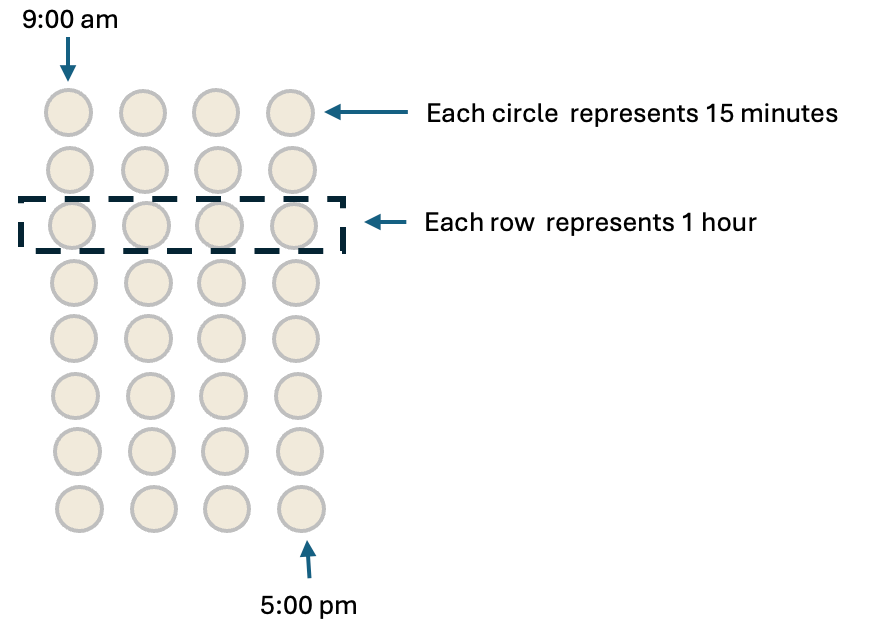
The diagram below represents your workday in 15-minute increments. Think about what you did yesterday and note the 15-minute increments that actually mattered to you. I’m going to guess your most meaningful accomplishments were completed within an hour or less.
More than a decade ago, Tim Urban, author of the Wait But Why blog, wrote an article about a human life in weeks. I first read it when I was transitioning out of Breather and into The Muse, back in 2019. At the time, I didn’t want to read it because it made me realize how far into the “life grid” I was and how much irrecoverable time had passed. My first reaction was to look away in shock, as if encountering a horrific sight. I generally don’t want to think about my life being corralled into this box of limited weeks.
Since I read that blog post, I couldn’t stop thinking about how time looks when we map it out in such concrete terms. It kept resurfacing in my mind when I felt I wasted my time on something inconsequential. The post made me realize that I want to be more deliberate about what I do with my time (what I say yes and no to) as I get older.
Using Urban’s style of graphic organization, let’s take a look at the units that make up our worklife–our workdays.
Let’s talk through this.
Most days, we open our computer, and it’s as if we’ve entering a video game in which our playing time has been predetermined by someone else. The game is set, and we simply click accept to every invite, email, and project that comes our way. We may feel like NPCs at times, robbed of any true agency. Besides, saying no to a meeting might involve explaining ourselves, and we just don’t have the time for that! We’re already overwhelmed with the daily grind, and so we take the path of least resistance. Hours later, the timer runs out. We’re exhausted. And somehow, despite all that activity, the level that actually mattered never got played.
Here’s the problem: taking the path of least resistance leads to resentment.
There’s a good chance this experience I’ve described feels familiar to you.
Most of us want to change the way we experience our workdays but we tell ourselves, “well, this is just how work is.”
Time is an abstract concept, and as mere humans, we rationalize time lost more often than we realize. A common rationalization I use: “This week got away from me.” But we respond emotionally (really emotionally!) to seeing our time disappear.
I’m going to take you through my grid method, an obsession of mine as I reclaimed control over my time in pursuit of pushing my priority forward. Hopefully, in making the abstract concrete, you will feel empowered to rethink your own daily schedule, too.
1. The first realization I had when seeing the day in these simple terms is this: there aren’t many circles in one day. Think about a 15-minute time block. Every time you run out and get a coffee, one circle disappears. Here is what a typical day in my workday would look like:
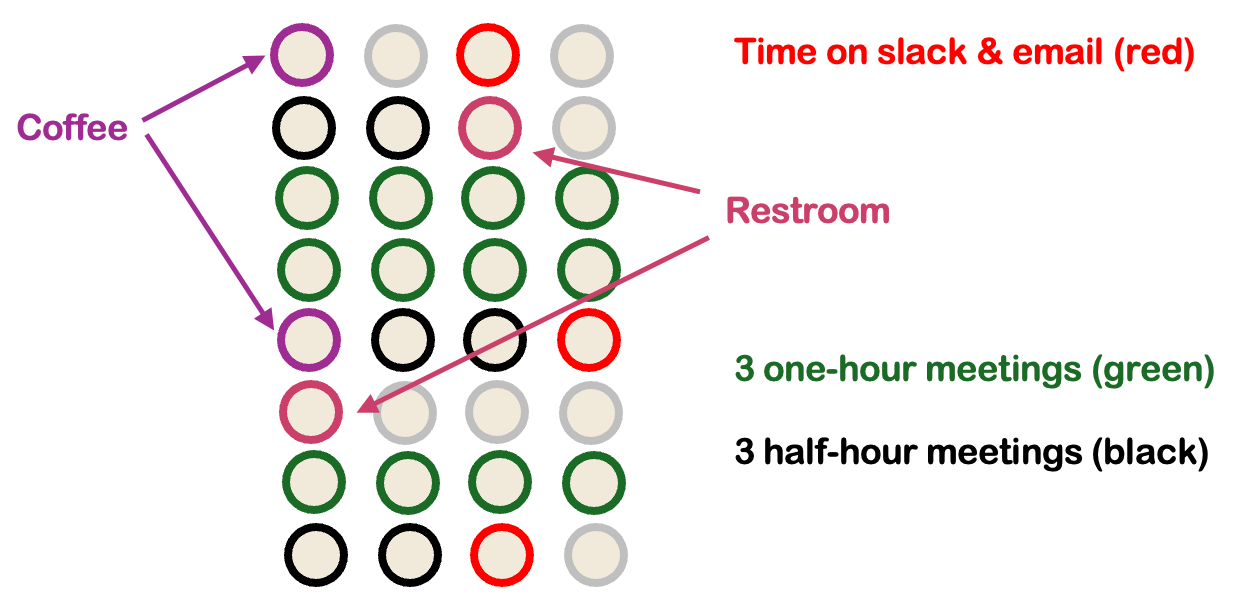
This seems like a typical day for most people. Managing activity, not outcomes. A patchwork with some scraps in between. What kind of decisions or strategic work are we forcing into those 15-minute scraps?
2. What do most of us do to solve this problem? We tack on time in the morning, and then more at night while wiping out our “what we will” time. The time that belongs to us, not to work or anyone else’s agenda, popularized by the major 19th-century labor reform movement. Extending the work day feels responsible but it’s a workaround for not having prioritized the most important work.
Even as we extend our work days, this is not a sure way of driving more productivity and less anxiety about piling up responsibilities. When we “tack on” time, we often keep up the same chaotic pace.
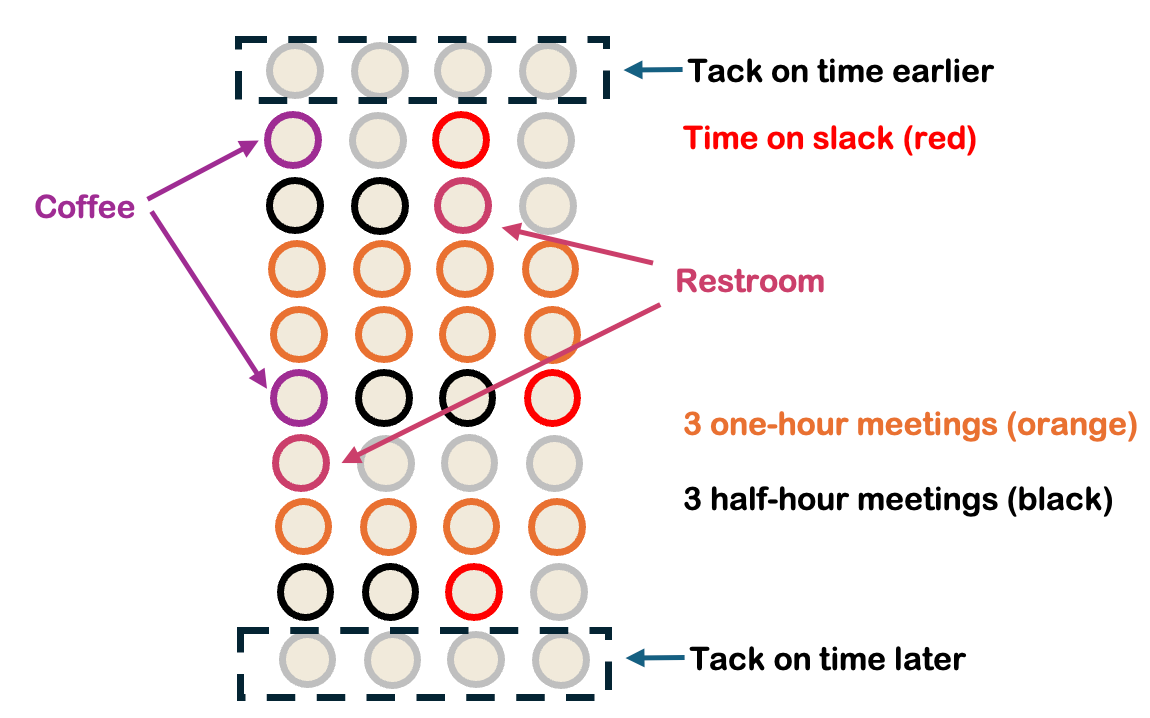
This supposedly gives us more work hours in the day, but it comes at an opportunity cost: not being with our families, not going on the run to take care of our bodies, not cultivating any hobbies.
Still, I tricked myself into believing I’d discovered a brilliant time hack. I’ll wake up earlier and stay later to get my deep work time. But more often than not, I would review my to-do list during this newfound time, pick off the easiest tasks, and knock them out.
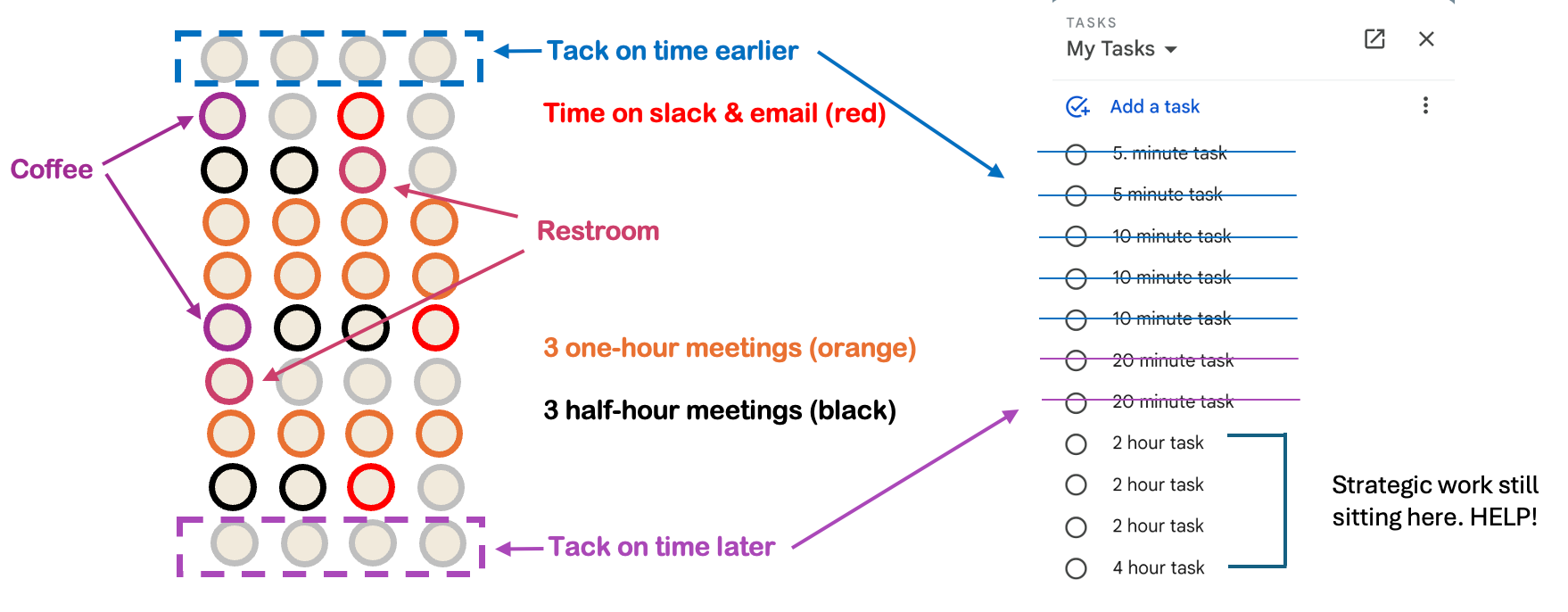
I felt great. I was knocking out items on my to-do list and the list was getting shorter. I finally had momentum!
But I quickly discovered I was making a fatal flaw. Clearing simple tasks on my to-do list didn’t move the needle and as I prioritized them over more strategic work, I grew more anxious. I often asked myself: when am I going to get time to work on these more needle-moving projects? The urgent - important work is still sitting there, staring me in my Google Tasks bar.
3. So, I started reorganizing my day. I time-blocked my calendar in the morning to put one large strategic project in my day when my brain was fresh (I’m a morning person.) I pushed all of my meetings into the middle part of my day, and I tackled the smaller, lower-lift to do items at the end of the day, when I was tired and didn’t need to seriously concentrate. Here was the revised structure of my workday visualized:
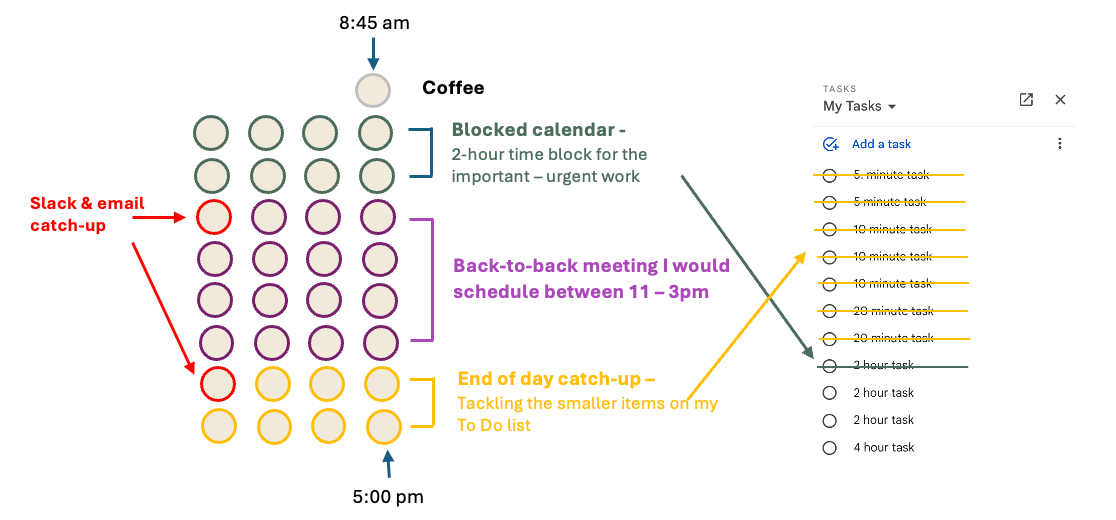
This was finally an unlock for me. Here’s why:
- I’m someone who likes structure. When my days are chaotic and disjointed, it saps my energy. Rethinking and restructuring my day improved my energy, focus, and workflow.
- I got a large block of focus time in the morning, when my brain wasn’t fried from context switching all day. This was the most important output of this time shift. I felt accomplished at the end of the day, knowing I progressed a big strategic project. My new schedule afforded me more patience throughout the day. No longer exhausted by a chaotic schedule, I could slow down and listen to my colleagues and teams.
- Best of all, I wasn’t tacking on time at the start and end of my day, thereby losing my “what we will” time. I did my work, I felt accomplished, and I still got to see my family and go for that run.
Admittedly, there were still a few problems. I planned my day almost too perfectly. I didn’t leave any room for the shit that hits the fan, or the unexpected call I needed to take, or the customer/partner meeting that went a bit too long. I tried to cram every to-do I had in each day rather than looking at my list and saying: What doesn’t deserve time in my day today? What isn’t important-urgent?
4. I took another stab at adjusting my schedule to allow for those “life-happening” moments in the middle of the day. Here’s what it looked like. You’ll notice a few time increments that are unassigned (grey). Let’s call those “spillover buckets” for the stuff that doesn’t go as planned. I also illustrate NOT tackling all of your to-do items, because not everything is important.
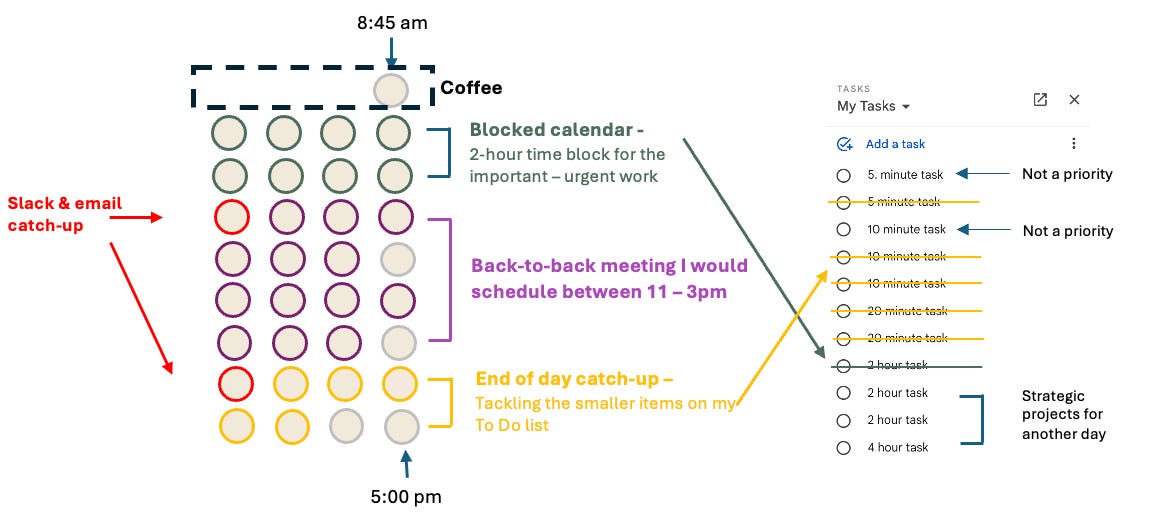
I had finally structured a day that works for me, taking advantage of when I have the most energy, leaving enough space for the unexpected, leaving time to knock out critical to do’s, and being able to go home feeling great.
There are a few things to keep in mind with this method:
- Shit happens, and it will throw your day off. If you can follow a method that works for you 80% of the time, you’re going to see measurable differences in your work life. Nothing can be perfect so don’t expect it. If you expect perfect, you will spiral downward
- Absolutely leave space for basic human needs. Getting water, eating, restroom breaks. If you expect to plan the day without time to be a human, then you won’t feel like a human. We are not bots!
- Maybe you’re not a morning person, and your best thinking is at night. Simply invert this schedule. The point is, tailor your day to work for you and your priorities. That’s the beauty of visualizing our days like this. We have more control over our time than we realize.
Every day hands you a small number of circles. If you don’t decide where your time goes, other people will.
Thanks so much for reading and please consider subscribing to The Revive. My mission is to help people feel happy in their careers.