You can read more and follow David Bethoney’s newsletter at The Revive.
I’ve watched talented people get shaken by a single bad quarter.
Not because the situation was irrevocable, but because they couldn’t absorb the hit and keep moving. Self-doubt typically strikes first, followed by an endless negativity loop.
I’ve spent the past decade inside startups, and I’ve had my own resilience tested in trying moments. Moments like a funding round that collapsed with weeks of runway remaining or a key team member who handed in their resignation at the worst possible moment.
In each of those moments, the question wasn’t whether or not things were hard.
Of course they were.
The question was whether I could function inside the difficulty, all the while thinking clearly, holding the team together, finding the next move in a fog of chaos.
Each time I’ve met a work crisis, I’ve had to be resilient. I’ve heard many “You’re super resilient,” and “You get back up,” comments thrown at me over the years, and I take pride in being a resilient leader. But sometimes pride can blind you.
In trying times, we’re so busy bouncing back that we forget to ask whether we should be bouncing in a different direction entirely.
So, I want to talk about resilience: What it actually is, how we can cultivate resilience, and what we often get wrong about resilience.
There are two kinds of resilience. The first is the kind I described above–staying calm, practicing self-compassion, avoiding the quicksands of self-pity. We’ll call that the good kind.
The other type of resilience, we’ll call performative resilience, needs to become recognizable to you. And right now, in a working world that rewards endurance above almost everything else, most people never learn to tell them apart. That gap costs us more than we realize over our careers.
What Real Resilience Actually Builds
Real resilience, the kind built when we work through challenges—both the ones we’ve deliberately chosen and the ones life throws at us—changes us on a cellular level. Every time we navigate a new hardship, our brain has evidence that we are capable. Work long enough, and you will have a trove of grounded evidence reminding you of what you’re made of, built through specific conditions that tested you over the years.
Think about the moments in your career where you were in over your head (we have ALL had these moments). Maybe it was the first time you led something that actually mattered and could fail. Or maybe it was when someone looked at you in a moment of crisis, and suddenly, you were anointed the leader and you were freighted with responsibility.
We probably didn’t feel resilient in those moments. We likely felt scared, uncertain, maybe even fraudulent (imposter syndrome is real in these moments). And yet, we did what needed to be done.
Resilience changes how we make decisions under buckling pressure. It changes our relationship with failure, not because the possibility of failure stops mattering, but because we’ve already proven that we can absorb it and keep moving forward. Most importantly, resilience changes our relationship with ambition. Real ambition requires the willingness to risk real failure, and we can only afford that if we trust that failure won’t break us.
I’m naturally optimistic. My default is forward motion. I’ve come to understand that optimism and resilience are connected, and they feed each other. If you’re wired similarly, that’s worth recognizing because it’s rare. Doctor Rick Hanson famously uses a metaphor to explain how our brain has a natural tendency to focus on the negative.
“Our brain is like Velcro for bad experiences and like Teflon for good ones.”
Due to evolutionary survival mechanisms, our brains are wired to focus on the negative and let positive experiences slip away. If you happen to be naturally optimistic, you may not need to work as hard to overcome this bias. But there is something worth watching out for: optimism can mask the moment when real resilience quietly becomes performative resilience.
Let’s talk about the other kind of resilience.
The Other Kind: Performative Resilience
Back in 2019, when I joined the Muse, most of our millions of monthly users arrived via Google after finding one of our thousands of career articles in their search results. The problem was that very few of them knew we had a job board, let alone interacted with it.
We spent months in weekly exec meetings planning tactics to convert content readers into job board users in a way that felt organic and didn’t force people to build extensive profiles. Each time, we’d align on a plan, set our engineers loose, and wait for results.
Nothing moved. Over and over again, we would deploy a new tactic, same outcome, no material impact. We kept getting back up, forging ahead with more resilience each time. But we were operating inside a broken system. We didn’t have the right expert at the table.
This is performative resilience in the making. We were in denial about our ability to solve the issue in question, and we kept pushing through.
So we paused. I went out and brought on a Head of Product who had a proven track record of materially impacting online marketplace conversion numbers. Here’s the important part: it took me two months to get this person onboard. Imagine all of the negative self-talk: You’re wasting time! We don’t have two months to wait. We need results now!
Within 3–4 months of his onboarding, we saw a >150% increase in the metric we’d been banging our heads against for nearly a year. You can see the result very clearly in the graph below, which represents user conversion from Muse advice articles to the Muse job board.
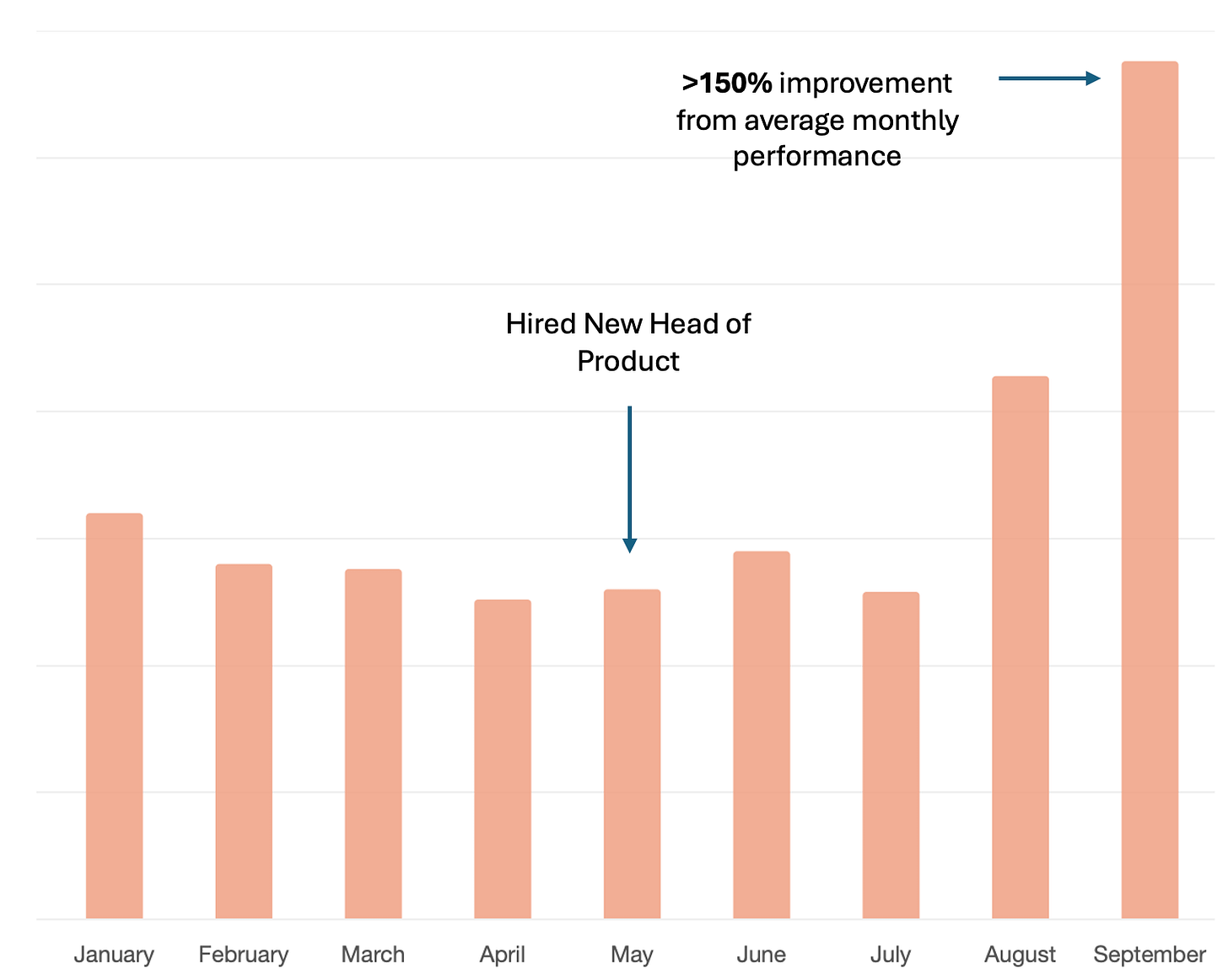
We could have kept forging ahead with more resilience, more persistence. Instead, we recognized our approaches weren’t working. We had resilience but no destination. We picked up the bat phone and got to the result in a different and much quicker way.
When our default is forward movement, the idea of pausing to ask whether we’re moving in the right direction can feel unnecessary. The “one step back” feels painful. Why stop when stopping wastes time?
The pause wasn’t free. Two months to hire, three more to see traction. But a year of performative resilience had been far more expensive.
This is precisely where the second kind of resilience enters. And it doesn’t make itself known. It arrives very gradually, almost in a sneaky way.
We’re still showing up. Still killing ourselves to deliver. Still the person the room turns to when things get difficult. Still accepting compliments on how resilient we are. From the outside, nothing has changed. From the inside, something has.
The difference is destination.
The first kind of resilience has a specific destination. We’re pushing through something difficult because on the other side is a version of ourselves that doesn’t exist yet. Our discomfort has a direction. We can feel it even in the hardest moments, something building underneath the difficulty, and a sense that our effort is taking us somewhere real.
The second kind has no destination. Like my user conversion example above, we’re enduring rather than growing. The challenge in front of us today looks like the same damn challenge from six months ago. Doh! We’re not being stretched toward something new. We’re being tested by the same test.
That’s what makes performative resilience dangerous. Not that it breaks us. It doesn’t. It keeps us performing beautifully on the outside while something underneath goes awry. Everyone is complimenting us on how we are gracefully handling stress and overwhelm, but the system is suffering.
Real Resilience vs. Performative-Resilience: How To Tell Them Apart
Ask yourself two questions. Answer them honestly rather than quickly:
Is this difficulty increasing my ability to create meaningful change or just my tolerance for difficulty?
Am I expanding my capacities? Or am I just bandaging recurring issues over and over rather than finding solutions?
That’s the distinction I’m talking about.
If you feel like the challenge in front of you is building your confidence and credibility, it’s probably the right kind of resilience. A good “tell” is if you feel enthusiasm to solve the problem or progress the project. You will know it when you feel it.
If you feel like you’ve been working to solve the same problem over and over, the problem is draining your soul, you’re putting another band-aid on it because the old one was ripped off, that’s information you can use. Not a reason to panic.
The people I’ve witnessed build momentum in their careers are not only resilient, but they are honest about where to apply that resilience. They push hard through worthy challenges and build resilience and respect worthy reputations. But they recognize when their efforts are counterproductive and have the wherewithal to stop and redirect as needed. Not dramatically. Not a flip-the-table moment. Rather, a deliberate decision to channel their strengths in the right direction.
What To Do With This
I’m not suggesting you blow anything up in your career. The obligations we have matter, and not everyone has a safety net. The team depending on you is real. There are dozens of reasonable reasons why a dramatic exit is not the answer in most scenarios.
But here’s what I’ve learned.
If you’re building the good kind of resilience right now, stay in it. Let it build you. Don’t flinch from the difficulty. This is the kind of hard that compounds over your career. Don’t waste the experience.
If you’re in the second kind, you don’t need more endurance. You need redirection. Pause to think, instead of doing more. Reassess the situation. Ask: Why are we doing what we’re doing? Is it working, or is there another approach we haven’t considered yet? Offer a point of view. Volunteer to help clean something up, not because you’re struggling, but because staying close to the problem is how you start building again. Even a small act of meaningful intellectual engagement is how we find our way back to good resilience.
And, if you’re not sure which mode of resilience you’re using, that uncertainty itself is worth paying attention to. The first kind rarely leaves you wondering.
The Badge Is Real
I want to end where I started.
Resilience matters. I’ve watched what happens without it. I’ve seen talented people lose, not because they lacked skill or intelligence or opportunity, but because they couldn’t manage the hard parts. It’s part of why I think resilience deserves to be understood precisely rather than just blindly celebrated.
If you’ve built resilience, protect it. If you’re still building it, keep going. Teams need people who can work through challenges rather than admiring problems. Resilience matters more than most career advice will ever tell you.
Just make sure you’re swimming forward and not just treading water.
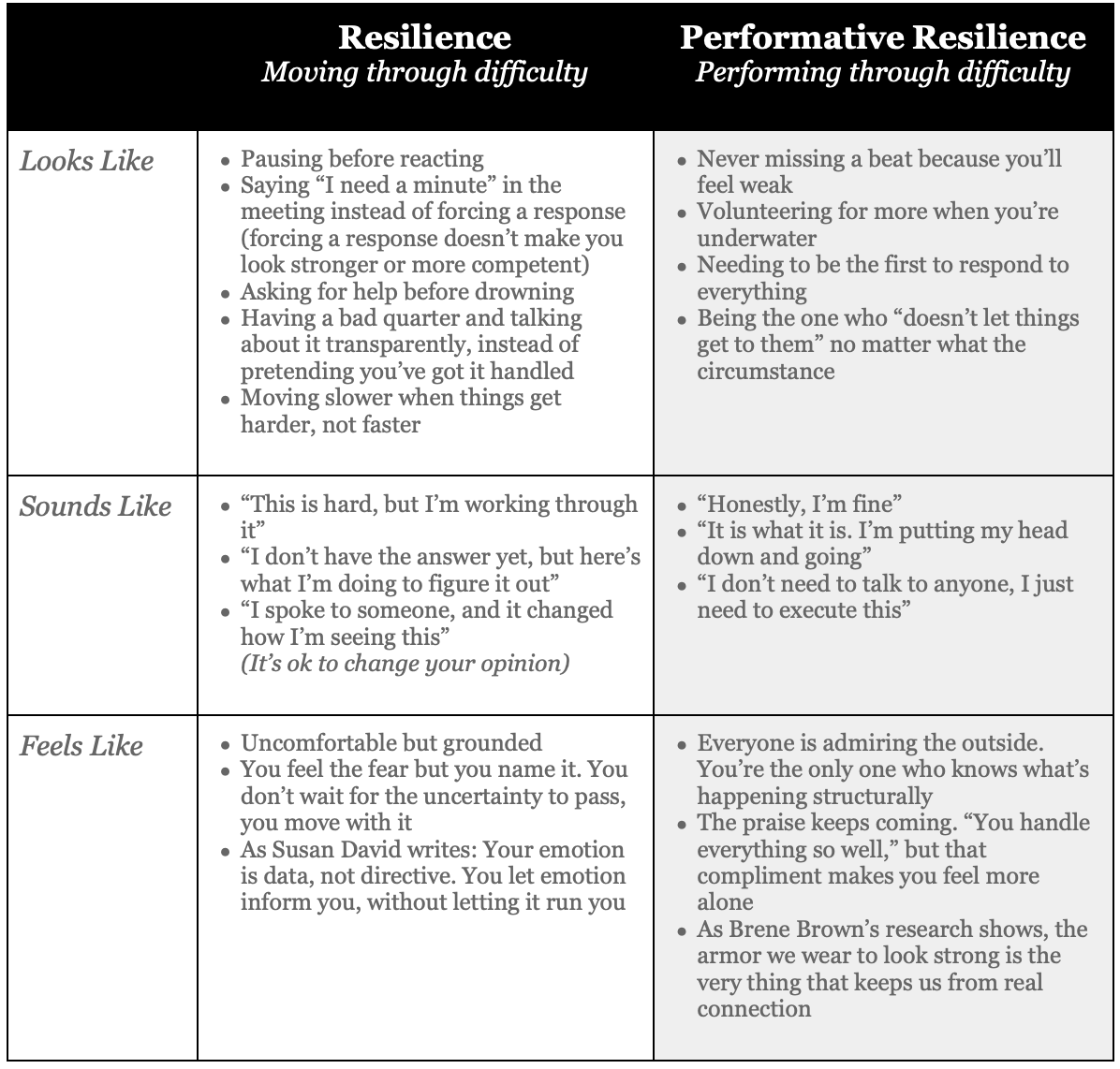
A lot of this work has been informed by Susan David, Brene Brown, Rick Hanson
Cool Read or Idea
As I was doing some reading for this essay, I came across a fable that illustrates resilience vs. performative resilience, and I thought it would be helpful as we explore this topic.
When the pressure builds, the instinct is to stand firm and push through. But the people who last aren’t the ones who refuse to bend, like the Oak that stood against the storm. They’re the ones who know when to pause, reassess, and adapt. Resilience isn’t rigidity. It’s knowing the difference.
You can read The Oak & The Reeds fable here. It’s a short one.
A special thanks to Mary Krawczyk, who helped take a lot of my messy ideas on this complex topic and provided invaluable feedback.
As always, thanks for reading, and hope your week is off to a great start.
Dave