You can read more and follow David Bethoney’s newsletter at The Revive.
Hi Friends,
There’s no better time of year to pause and think about what hard work means to you and how it shows up in your life.
We hear versions of “work hard” over and over again from a very young age, right through the time when we enter the workforce. Then it only intensifies from there.
When we hear this, it always seems to be delivered in a matter-of-fact tone. It often sounds a little like:
Work Hard
Stay Hungry
Don’t Quit
Very rarely do we ever talk about what working hard actually means. I recently caught myself repeating one of these slogan-like sayings as I was talking to my son. It felt a little like I was testing out Nike’s next tagline (Although I like “Just Do It”).
Let’s talk through this.
It was a Tuesday night, and I thought I was giving my son some perfect nugget of life advice while sitting at our dining room table, digging into what seemed like an endless amount of homework (when I was 10, I don’t think I got half as much homework on a nightly basis). My son had been working on his English homework and flipped into a writing assignment about a current event for class, due later that week. As I’m sure those with kids have seen over and over during homework time, he dropped his head to the table and let out a “Can I just watch some TV?”
For context: he just turned 10, is in the 5th grade, and has a lot of energy. Getting him to sit down for two hours at night, after sitting in school for 6 - 7 hours a day, takes a lot of effort.
After his TV question, I barked back:
“Watch TV? You have a pile of homework, and it’s 7:00 at night. Of course you can’t watch TV. I know you’re tired, but this is life. You have to work hard. Pick your head up and get to it.”
I went to bed that night thinking a lot about that interaction. And it dawned on me that we’re always hearing others tell us “work hard” or “keep your head down,” as if there was a dial in us and we just needed to turn it to the right and boom, we operate in the “work hard” zone.
We never actually learn how to work hard. What does “working hard” mean? And most importantly, does it mean the same thing to a 15-year-old vs. a 45-year-old?
Before we talk about what “working hard” means, the discussion would be incomplete without acknowledging how talent fits into the equation. When most of us see an amazing performance, the first inclination is to associate that with natural ability. “What amazing talent they have,” or “Man, I wish I could perform at that level.” Or my favorite: “They have such a natural ability to do that. It must come so easily to them.”
They’re usually said with a sort of finality, as if being excellent at something were a trait you’re either born with or not. As if what we’re really admiring is a natural ability that lets a person skip the hard parts. To be clear, I don’t doubt that there is such a thing as natural ability. But why is our FIRST instinct so often to reach for natural ability, instead of “Wow, that person must have worked super hard to get to where they are?”
As I was pondering this, thinking back to when I used the natural ability argument, this line of thinking led me back to an observation from Friedrich Nietzsche, a German philosopher, whom I first encountered 5 years ago while reading Grit, by Angela Duckworth.
“Our vanity, our self love, promotes the cult of the genius,” Nietzsche said. “For if we think of genius as something magical, we are not obliged to compare ourselves and find ourselves lacking…..To call someone ‘divine’ means” there is no need to compete.”
Put another way, when we valorize talent and minimize the value of effort, we let ourselves off the hook; we excuse ourselves from the work. After all, the winner wins because of talent, not hard work (or so we’ve believed). Talent is a well studied topic, and yet research can’t seem to agree, often elevating it above hard work in one study and diminishing it in another. It sort of reminds me of reading research headlines about coffee (if you know me, you know I’m obsessed). Depending on the headline, I’m either dead at 50 for drinking more than one cup a day or alive until I’m 100 because of its health benefits. I hedge my bets and stick with 2 cups in the morning. I digress. But that brings us to the part we tend to overlook: what “working hard” really looks like when no one is calling it talent.
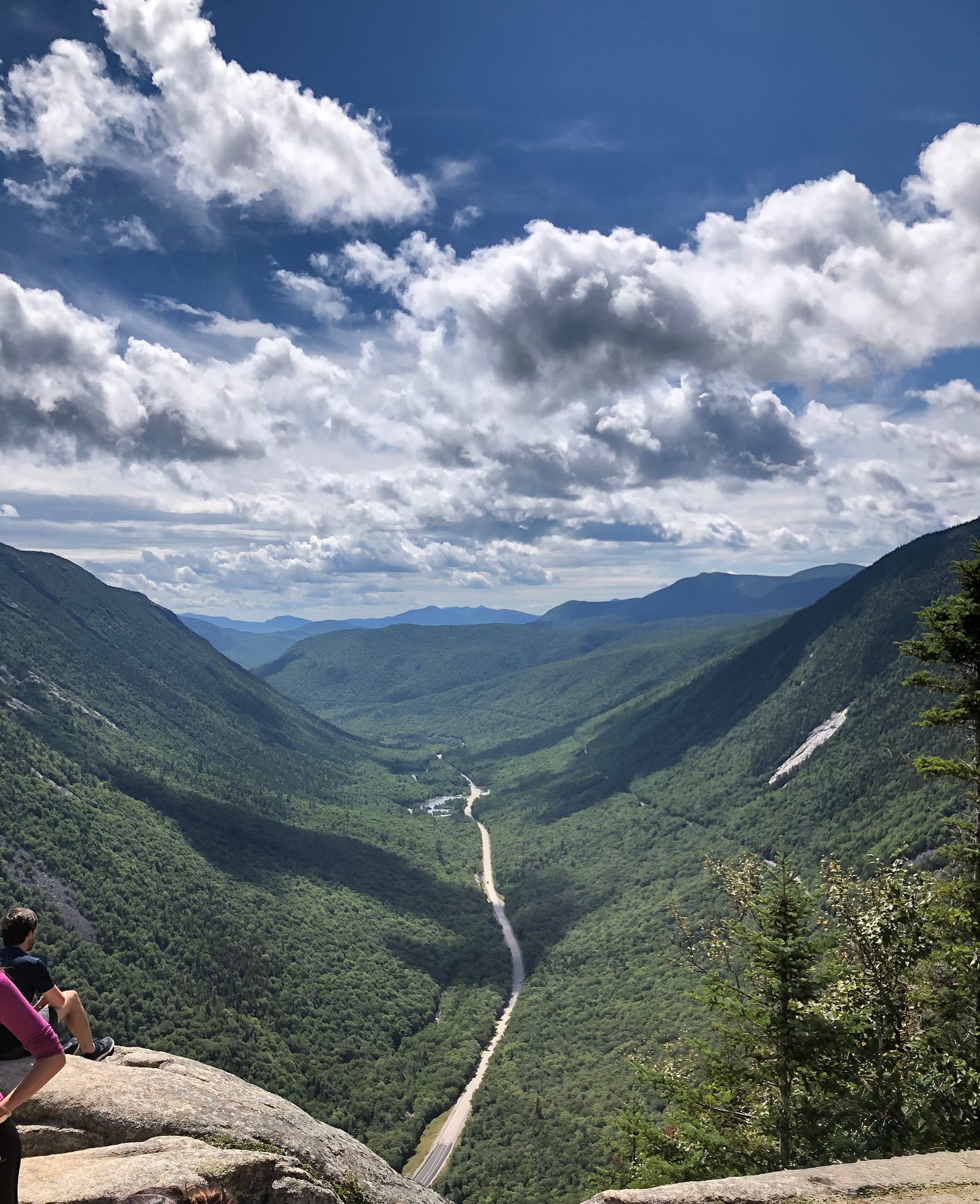
Mount Willard trail in NH. I hiked this 3.5 mile trail with my 3-year-old on my back in a carrier. It was some serious hard work in the most literal sense.
What Hard Work Means
Over the winter break, I ran a quick, informal poll with 20 people. For the data geeks (like me) out there, this isn’t some statistically rigorous survey. It is meant to be a quick qualitative pulse check. I asked a straightforward question.
What does hard work mean to you?
It was an open-ended question, no multiple choice, and no leading those who graciously humored me down a certain path. I just listened. The group of people I sent this to have 15 - 20 years of professional experience. 10 people in start ups and 10 people in large companies (we’re talking companies with well over 2,000 employees).
Here is a summary of the responses I got.
- 7 people described hard work as the amount of effort they put into a task (these people had no commentary on the outcome of results they were going after)
- 4 people referenced “working on the highest priority task”
- 4 people described hard work as sticking with something consistently over time
- 3 people described hard work as doing the least amount of work for the biggest gain. Put another way, they were hitting up against ROI
- 2 people described hard work as those scenarios that drove the highest amount of stress
Although there are groups of people with similar responses, everybody had a slightly different way to describe what hard work meant to them. It was a fun, informal discussion topic, and I was struck by how this question opened up memories and subsequent conversations about personal stories of struggle and commitment.
Here’s the point I am reflecting on after this funny little exercise: In the end, hard work doesn’t have a universal standard; it’s a personal definition, and it changes depending on the phase of life we’re in. The way we define hard work should be in service of the individual success we are trying to create, and success looks different for everyone.
For me, hard work and motivation have meant very different things, depending on the stage of life I’m in. When I was 20 years old, I viewed hard work as grinding through 80 hours a week, and giving little thought to what I was doing or if it mattered. I was motivated by the fear of failure. I kept my head down and did what I was told. As I’ve matured, hard work means going into work every day, giving it my all, coming home, and making sure I’m present with my family. Listening to them, loving them, and engaging with them about their days. Then, turning to finishing up work when necessary, or writing for this newsletter. When I have an off day or when I’m not as productive as I was hoping to be, I feel like shit. I feel like I didn’t work as hard as I could have, and it impacts my mood. That feeling is rooted in the work ethic and sense of commitment I absorbed early on, watching my parents.
Our own versions of hard work don’t need to match others to be legitimate. Hard work is an honest attempt to contribute to our families, our communities, and the lives we want to shape, whatever our circumstances. When we’re young and scrappy, we want to prove our worth, and so we overwork ourselves to find the thing that matters to us. Then we mature, we establish a track record, and we realize this kind of work-at-all-costs approach is no longer sustainable (or required).
Hard work is a dynamic concept, shaped by our age, experience, and responsibilities.
So, the question for us as we kick off 2026 is: how will we each define hard work this year? Perhaps start with this exercise, from a recent George Saunders post titled “Flying Elephants.” It can be applied to any circumstance.
I always advise my third-year students, who are about to re-enter the world, to take an afternoon alone and do some serious thinking about what they’ve learned during the three years of our program. What do they actually need to be creative? How many hours a day? What conditions have produced their best work? Are there any myths (about process or approach) that they are ready to reject, given their experience of having been a full-time creative person for the last three years?
I ask them to take a good, honest look at their nervous systems and patterns of work and rest, and all of that, and think about how, practically, to design a life that will continue to support their work.