You can read more and follow David Bethoney’s newsletter at The Revive.
Our culture is fixated on meetings: the 1:1 recurring meetings; the meetings to talk about the agenda for other meetings; the steering committee meetings; the recurring sales forecast meetings; the every two-week, All Hands meetings; the brainstorm meetings. It’s a never-ending stream, and right when you think there is a reprieve, you receive another meeting invite.
I started thinking about this when I saw Howard Lerman, CEO and Founder of Roam, post this on X recently in response to a Forbes article.
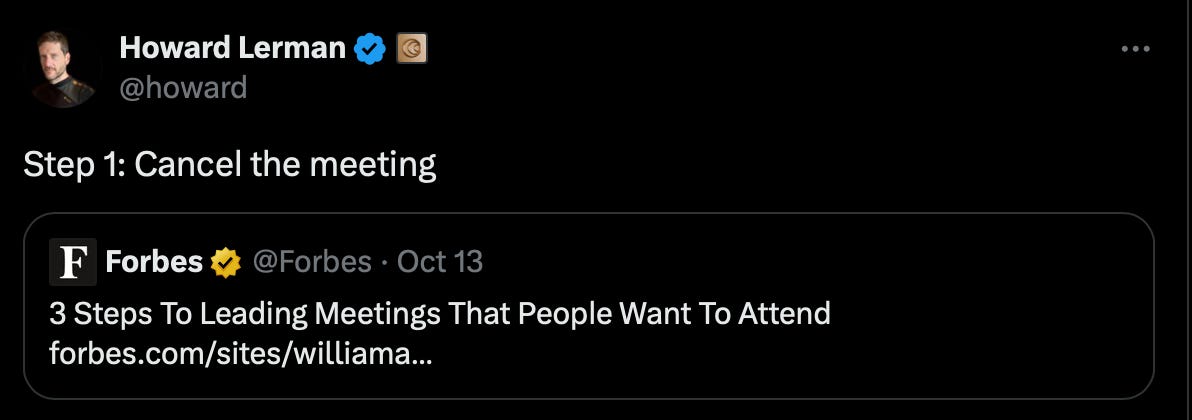
Howard’s response made me laugh. It also struck a nerve with me because it highlights a surrender we’ve normalized.
We’re all familiar with the collective relief we feel when a meeting is canceled. We’ve all witnessed our colleagues suffering from meeting malaise, staring into the mid-distance like The Children of the Corn. We grow resentful when others fill our calendars, dictate our focus, and shape our workday. This often comes at the expense of doing valuable work that actually matters.
Meeting overload isn’t a new subject. Somewhere along the way, we stopped asking, “Should I be in this meeting?” and started assuming that an invitation is an obligation, or even a privilege; and, in the process, we quietly outsourced one of the most important things we have control over: our attention.
Let’s talk through this.
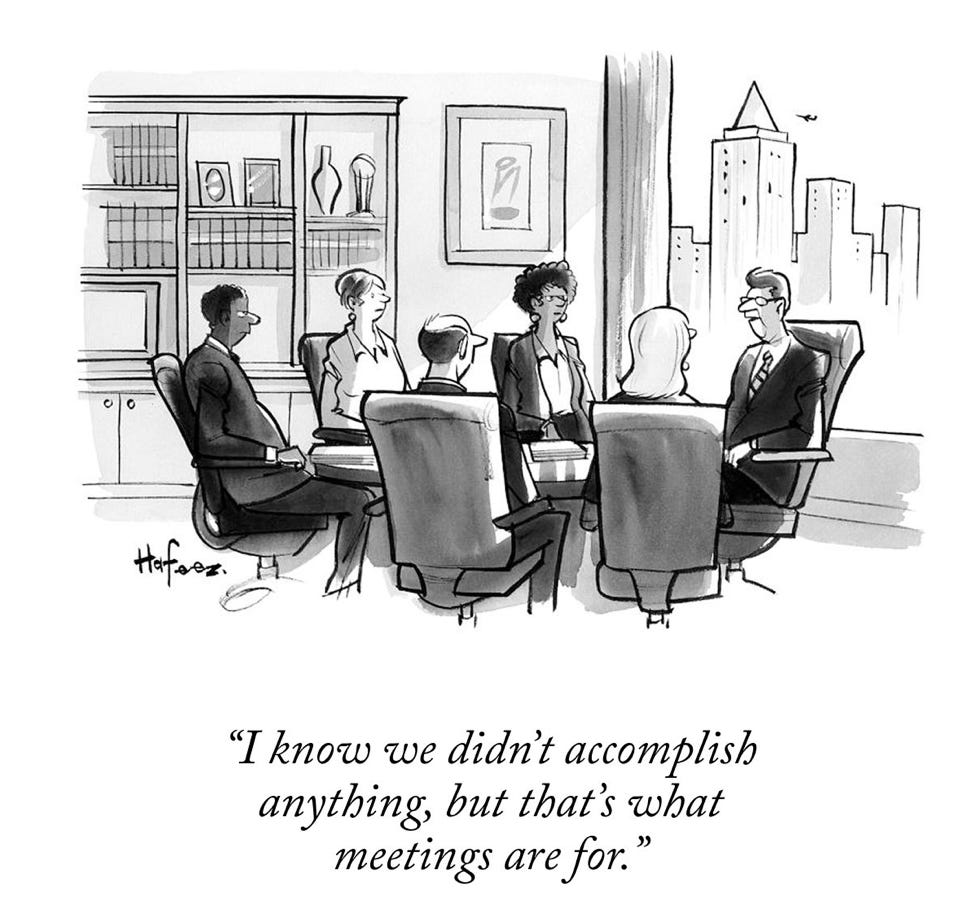
New Yorker
Saying “Yes” to everything
It’s Sunday night, so naturally, time to flip open that calendar to see what the day will be like on Monday. The Sunday Scaries creep in as horizontal event bars blur together like a suffocating blue wall. You start to wonder, “When am I going to eat, or even use the restroom?”
In my role at The Muse, my calendar often looked like this.
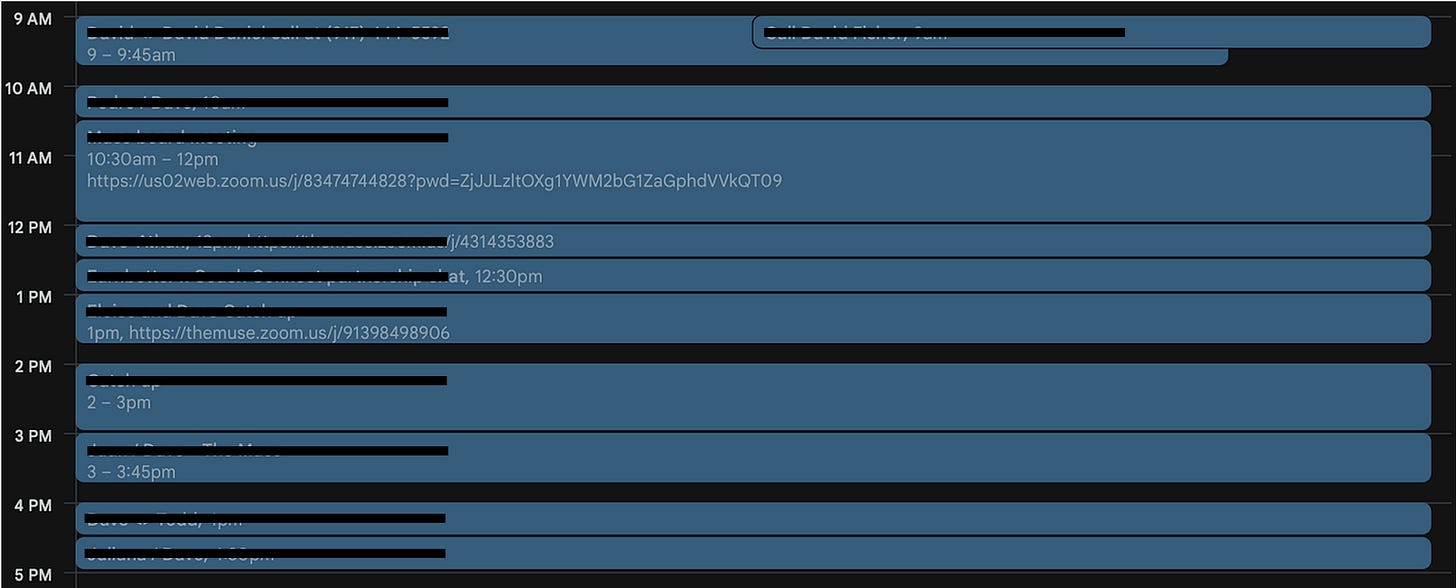
Every day, we open our calendars to discover that other people have already made decisions for us: meetings we didn’t schedule, priorities we didn’t set, obligations we don’t fully remember agreeing to. At some point, our work became less about choosing what matters and more about managing what’s been chosen for us.
When I was younger and starting out at Microsoft, I would be the first to accept that meeting, volunteer for that presentation or assignment, and jump in on that email thread. My calendar quickly filled up. I mistook activity for achievement, and I thought the more I inserted myself, the more valuable I became. After all, by saying “yes”, we become indispensable, right?
I was in my third year at Microsoft, working within the Microsoft Dynamics group where I served as one of two Finance Business Partners supporting Satya Nadella, then the Head of Research and Development. We were deep in the annual budget cycle, cranking through endless hours and assembling hundreds of slides before higher-level meetings. It was the kind of workload that blurred the line between a “long day” and something that resembled light captivity (but hey, I got all the free chocolate milk I wanted). After logging roughly 80 hours one week, I left the Redmond campus to drive home and ended up pulling over on the highway because my eyes simply refused to stay open.

Washington State Route 520 bridge, crossing over Lake Washington. As a side note, the Seattle area is one of the most beautiful places I have ever lived.
Source: Reddit.
After all of the hours, meetings, and PowerPoint slides, I was left with popping Advil and a lot of questions:
Did I get the right work done?
Was any of it actually essential?
Did I move the business forward?
I had an unsettling realization: I’d been busy and overworked, but I didn’t feel very effective. The same feeling I have when I get to the end of my busy meeting day and think to myself, I accomplished nothing I wanted to accomplish today. I know I’m not alone in this feeling.
Why do we have so many meetings?
Meetings remain a key feature of our lives, even though there is consistent data that suggests excessive meetings can bring down organizations and negatively impact employee morale. We’ve all received the 4:59 pm Zoom invites, the never-ending 30-minute meeting that is closing in on 60 minutes, or the unexpected Slack message that asks you to hop into a Zoom session for a quick 5 minutes (it’s never just 5 minutes). When was the last time you declined any of these? Better yet, when was the last time you asked follow-up questions on the objective of the meeting before accepting the invite?
Meetings soothe our deep, primal anxieties: the fear of losing our belonging, being seen as inessential, or missing important information that could threaten our standing within the group. When we’re not invited to that ostensibly important meeting, we feel like we’ve been quietly voted off the island. The busier we are, the more relevant we feel. That’s why the most common answer to “How are you” in any office hallway (or in those 30 awkward seconds before a Zoom meeting) inevitably circles back to the same chant for corporate life: “I’m so busy!”
Recently, when I reviewed a Microsoft study, published in June of 2025, an important stat called out to me:
Half of all meetings take place between the hours of 9 - 11 am and 1 - 3 pm, during a time when most of us have a natural productivity spike.
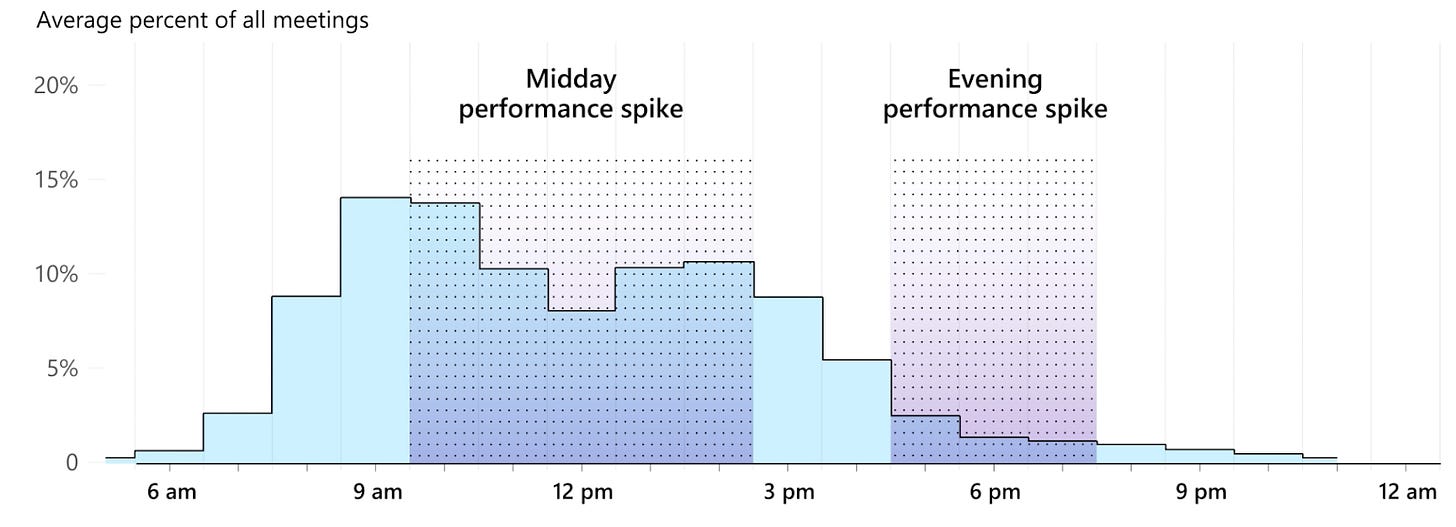
This schedule works against most of us. It ignores how focus and energy really function, handing our most productive hours over to meetings which can often be passive in nature.
Focusing our time on what matters
“There is nothing so useless as doing efficiently that which should not be done at all” - Peter Drucker
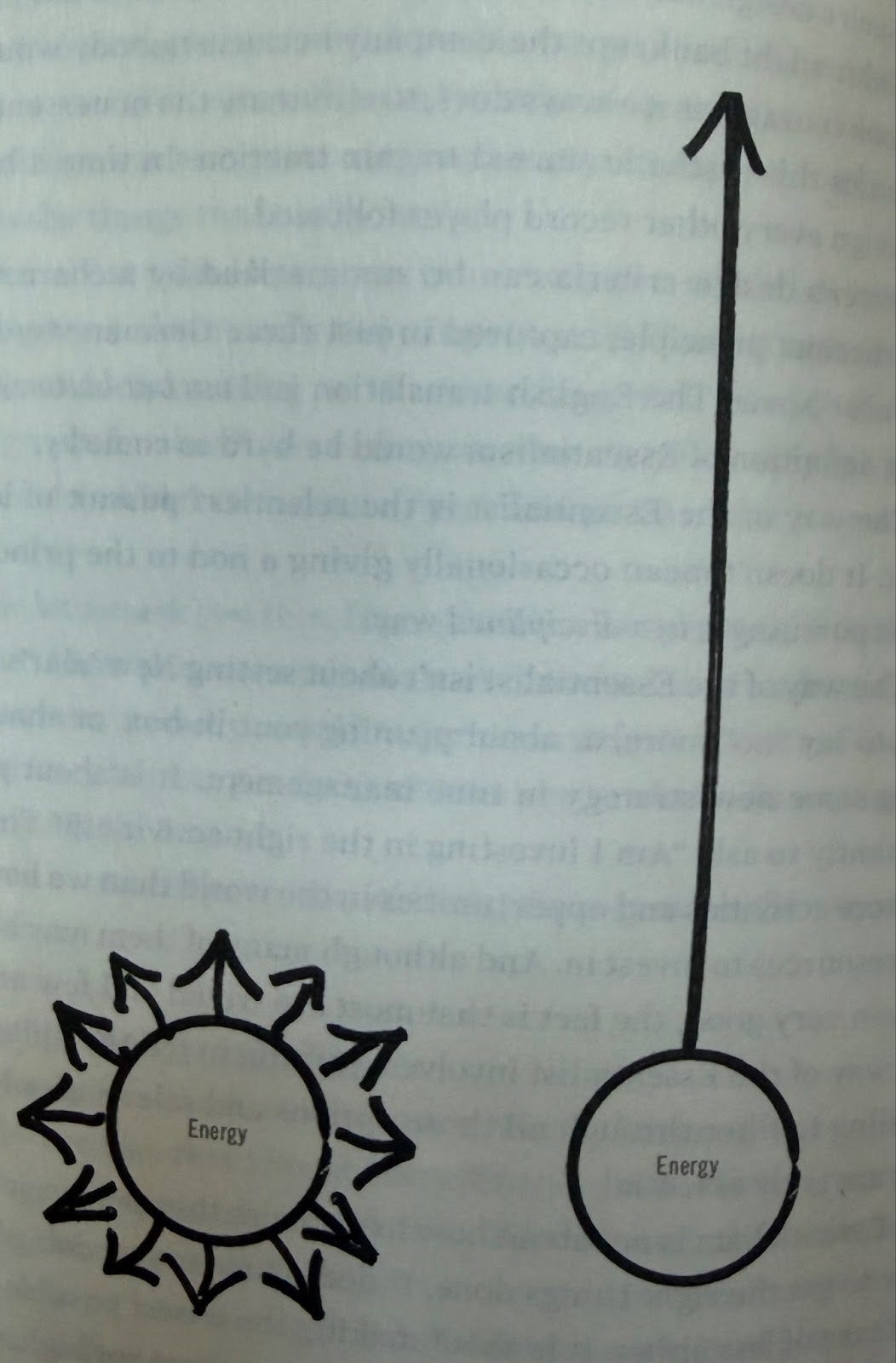
I periodically re-read the book “Essentialism” by Greg McKeown. Published a decade ago, McKeown advocates getting the right things done by discerning what is absolutely essential and eliminating everything that is not. It’s the difference between scattering our energy across too many pursuits and inching them forward, and committing to fewer endeavors where progress is not just felt, but sustained.
I think this is perfectly summed up by the diagram below.
Source: Essentialism, Greg McKeown
Here is an excerpt from the book that summarizes what being an Essentialist is:
The way of the Essentialist means living by design, not by default. Instead of making choices reactively, The Essentialist deliberately distinguishes the vital few from the trivial many, eliminates the non essentials, and then removes obstacles so the essential things have clear, smooth passage. In other words, Essentialism is a disciplined, systematic approach for determining where our highest point of contribution lies, then making execution of those things almost effortless.
As I’m sure many of us are thinking, this is incredibly difficult to do and much easier said than done. How do we weigh tradeoffs and decide what truly deserves our time? How do we stop defaulting to “yes” when our calendars and workload are already overflowing?
Essentialism asks us to confront these questions directly.
Saying No
Saying “No” doesn’t mean being defiant or difficult. It’s about protecting the priority that actually moves the needle. In practical terms, this starts with slowing down the reflexive yes. Pause before accepting a meeting, perhaps ask yourself:
- Do I understand the agenda for this meeting?
- What decision is being made here?
- What value am I adding?
- What value am I getting?
If the answer to these questions isn’t clear, seek to understand before attending the meeting; or, decline politely, professionally, and without guilt.
“I’m heads-down on a priority project and won’t be able to contribute meaningfully to this meeting. Can you send me a summary afterwards?”
“This doesn’t overlap with my core work right now, so I need to skip this one.”
I started small. When I realized my calendar was getting out of control, I started to decline one meeting a week. I removed myself from one recurring invite. I protected one uninterrupted block of deep work. I was open about this and discussed the change with my team. These tiny acts recalibrated my calendar around intention and I was reminded that I do, in fact, still control my time.
One attempt at The Muse to ensure employees had deep focus time was to institute Winning Wednesdays. Every Wednesday, between the hours of 8 am and 12 pm, we canceled all internal meetings. It was dedicated time to think, shift out of reactive mode and into creative mode, a gift far rarer than any of us like to admit. I never went home on Wednesday feeling as if I didn’t accomplish anything.
The truth is, no one will guard your time for you. No one will tap you on the shoulder and say, “Hey, you look overwhelmed, why don’t we cancel half your meetings?” What Essentialism and experience have taught me is that doing less isn’t lazy, and saying no is strategic. It’s living by design rather than by default. It requires discipline to choose what matters over what simply arrives in your inbox, discipline that can become second nature with practice. So, the next time your calendar overflows or another meeting invite appears, pause. Ask yourself: whose life am I living? Is it mine, or someone else’s? Choose accordingly.
Want to read more about this? Check out the links below:
Dave