You can read more and follow David Bethoney’s newsletter at The Revive.
Most people aren’t trying to build their own thing on the side. They’re just trying to do great work and then go home. This person is not behind the times. They are not naive. They are actually the majority.
But you wouldn’t know that from the internet. Another day goes by, and another post declares the corporate job dead. AI is coming for your title. Build a career portfolio. Create a personal brand. Diversify your income or get left behind. It’s loud advice, and for most people just trying to show up and do good work, none of this fits the life they’re living or want to live.
I want to push back on this narrative.
Not because the anxiety isn’t real and not because AI should be ignored, but because the story being told doesn’t seem right. It’s doing real damage to real people for visibility and clicks.
A very small, very loud group is shouting about the “spiraling of corporate.” The rest of the workforce is showing up, doing the work, and going home. They don’t have a Substack about it. 😊 They’re not building a personal brand. The dominant narrative of this professional moment has almost nothing to say to them other than start using AI and don’t just prompt it, use it deeper or your future is decimated.
We’ve been here before. Let’s talk through this.
Earlier this year, I posted this on Substack:
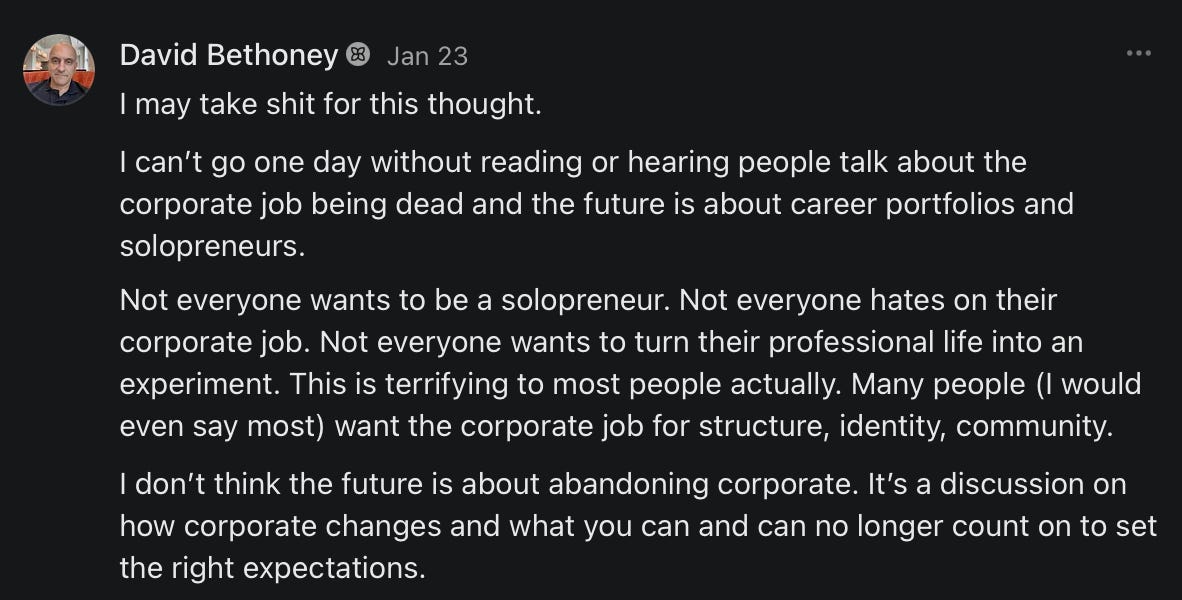
As the first sentence notes, I expected significant pushback for airing this thought. Especially on a platform that caters to being a hub for creators “to do their own thing.”
I didn’t get a lot of pushback. In fact, I got no pushback. Maybe my just starting out was a factor, as my posts are not in front of thousands of people yet. Or, maybe most people don’t disagree with me, even though this is all we hear in top posts and in big media publications.
We’ve been here more than once, just in the last 25 years
The declaration that corporate work is dying isn’t exactly new. We just keep forgetting we’ve made it before.
1993: IBM had gone its entire 80-year history without laying off a single employee. IBM’s culture was often referred to as “cradle to grave” while promising no layoffs. The business was famous for taking care of their employees in lavish ways. Then, in 1993, due to declining revenues, the company cut 60,000 jobs in a single year. This was the largest layoff in American history at the time and was an earth shattering story for corporate employees. Headlines called it the end of the corporate social contract. Business writers declared the era of job security finished.
In 1994, John Hoerr wrote about the IBM crash in an article titled “System Crash”:
If even this citadel of lifetime employment was forced to fire thousands of employees, is there any hope for job security anymore? What does the high-tech future hold for employees who may be bounced from one “virtual corporation” to another? If they cannot have job security, can they at least have employment security?
Sound familiar? IBM survived. And within a few years, the labor market moved on.
2001: The dot-com crash wiped out hundreds of thousands of tech jobs overnight. We heard more of the same then. The corporate world is broken; the future belongs to freelancers. Some people took that advice, and it worked. But the majority of the workforce went right back to traditional employment, because it was more stable.
This writer describes how people felt during the dot.com crash:
The bad times have begun. I’ve managed to survive three layoffs. I don’t know if I’m doomed or invincible, but I have seen all my friends get axed one by one. They may claim to be optimistic about it (“Despite the slowdown, the hiring market is still as hot as ever”), but all that uncertainty has started affecting their lifestyle. And mine.
These days, my friends and I accept it as a fact of life: Dot-coms are trimming the fat and at any time, any one of us could be considered expendable.
Again, sound familiar? We hear this sentiment daily.
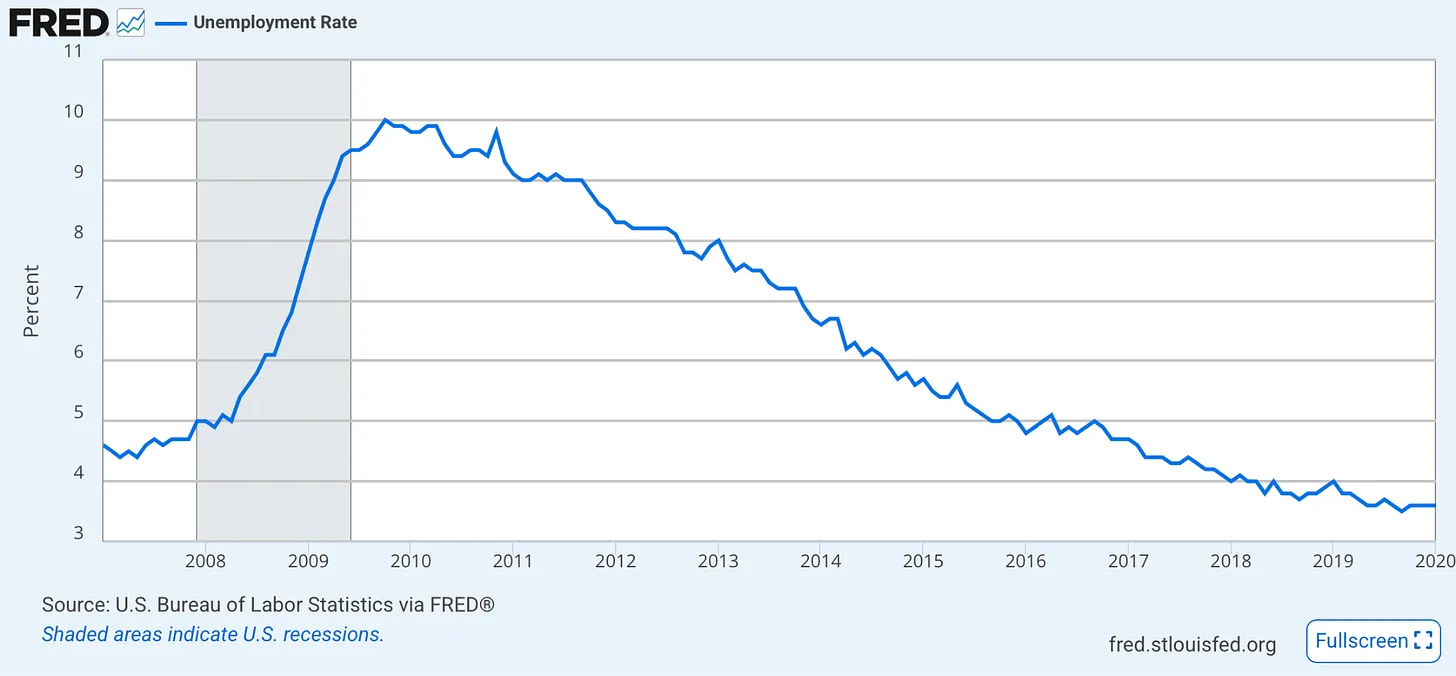
2008. The Great Recession. Unemployment peaked at 10 percent. More than 8 million jobs vanished. People talked openly about structural unemployment and that jobs lost were gone forever. At the time, I worked at Myspace and I remember walking through NYC one day watching the stream of Lehman Brothers employees leaving their office that September.
By 2018, nonfarm payrolls were 9.2 million jobs higher than at the start of the recession.
Perhaps the most defining article of that time, published in the Atlantic in 2010, summarized the despair people felt:
The Great Recession may be over, but this era of high joblessness is probably just beginning. Before it ends, it will likely change the life course and character of a generation of young adults. It will leave an indelible imprint on many blue-collar men. It could cripple marriage as an institution in many communities. It may already be plunging many inner cities into a despair not seen for decades. Ultimately, it is likely to warp our politics, our culture, and the character of our society for years to come.
The jobs came back. The economy recovered, and most of the dire predictions never fully materialized.
Three times in thirty years, the corporate job has been pronounced dead. Three times, it came back.
2026: And now, here we are in 2026, with “Something Big Is Happening” by Matt Shumer, and the “2028 Global Intelligence Crisis” by the Citrini substack, scaring the shit out of many people.
Except from Something Big Is Happening:
I think the honest answer is that nothing that can be done on a computer is safe in the medium term. If your job happens on a screen (if the core of what you do is reading, writing, analyzing, deciding, communicating through a keyboard) then AI is coming for significant parts of it. The timeline isn’t “someday.” It’s already started.
I’ll be honest: I think the AI revolution is more significant than the previous three I just described. The nature of work really will change over the next decade, and anyone telling you otherwise is selling you false comfort. It shouldn’t be blindly ignored. But, Shumer’s piece isn’t a balanced one.
Eric Markowitz, Director of Research at Nightview Capital, responded with a great essay:
Every generation has faced a version of this moment.
The printing press was going to destroy the church. The locomotive was going to destroy the human body. Electricity was going to destroy sleep. The assembly line was going to destroy craftsmanship. The internet was going to destroy truth. And every single time, the same question sat at the center of the panic, even if nobody quite said it out loud: are we our tools, or are we something more?
This is about our relationship with tools. It always has been. Tools are extraordinary. They extend what we can do, what we can reach, what we can build. But somewhere along the way, we started to confuse what a tool can do with what a tool should do.
But here’s the thing I keep coming back to: we have never, not once in our lifetimes, lived without uncertainty. Uncertainty is the only certainty in life; it’s the condition of being alive. Career uncertainty, health uncertainty, economic uncertainty; we navigate all of it, constantly. The question isn’t whether the future is uncertain or not. It’s whether we have a way of thinking about it that doesn’t paralyze us.
What the constant barrage of predictions actually does to regular people
Think about what it actually feels like to be a person who goes to work every day, does their job well, comes home to their family, and then opens their phone to find out they’re doing life wrong. That their reasonable choice, a paycheck vs. a pitch deck, is somehow evidence of a failure of imagination. The “corporate is dead” narrative doesn’t just make predictions. It makes the person who wants a steady job feel like they’re missing something, like their preference to not be an entrepreneur, is a character flaw.
It isn’t a flaw. Being in a corporate job isn’t the enemy of ambition; it’s frequently what makes ambition possible. It has been a place to focus on doing great work while building the kind of career that compounds over time. If you search deep down, get through the frustrations that are often attached to being in a corporate job (which by the way are also present in being an entrepreneur but in different ways), we actually like working. Work gives us a sense of community, shape and order to our days, and pride in our competence and accomplishments. Work keeps us sane. I know this to be true from me and the many people I’ve spoken with who have aired this exact sentiment.
The narrative we’ve all been hearing was built by and for a specific type of person: an already well-resourced, risk-tolerant person who has a safety net if their experiment doesn’t work out. Social media amplifies these stories because aspiration performs well. The unglamorous reality of steady work doesn’t get as many likes. But most people don’t have the luxury of romanticizing instability, and many people don’t want to.
Here’s the irony: most career advice right now is written by people who left corporate life. Which means it has almost nothing useful to say to the people who stayed and made a perfectly rational, even wise, decision in doing so.
So what’s actually happening right now?
The contract between employer and employee is being renegotiated. Again. It’s genuinely uncomfortable, but it isn’t new.
The old deal of showing up to the same job and being loyal broke down in the 1970s and 1980s when shareholders became the primary focus.
In 1970, Milton Friedman ushered in the era of shareholder primacy with a much-quoted essay in the New York Times, titled “A Friedman Doctrine—The Social Responsibility of Business Is to Increase Its Profits.”
What replaced the original contract was an implicit understanding: we can’t promise you forever, but we’ll invest in you, treat you fairly, and give you work worth doing. That deal is now being renegotiated again, under pressure from AI, remote work, and generational shifts in what workers actually want from their careers.
That renegotiation will be messy, and most companies are going to handle it badly. Companies will demand more while offering less, using fear and uncertainty as a management tool. That’s real, and it’s worth calling out. But a poorly renegotiated contract isn’t the same thing as a contract dying. The question worth asking isn’t, “Should I abandon corporate work?” It’s, “What are the new terms of this contract, and can I live with them?”
Here’s what I believe
Corporate jobs aren’t dying. They’re changing the way they’ve changed before, in ways that are genuinely disorienting and require real adaptation. The people who navigate this era well won’t necessarily be the ones who abandoned the traditional path. They’ll be the ones who understood the new contract clearly enough to decide whether it worked for them.
That might mean staying. That might mean leaving. That might mean negotiating for something different. None of those choices makes you naive or behind the times.
If you’re someone who finds meaning in their work, takes pride in being good at it, and wants the security to keep doing it, that’s not a bad thing. It’s OK to like your corporate job. I know you don’t need to hear that from me, but it’s not being said by anyone.
Cool Read or Idea
Isabel Berwick, Financial Times journalist and writer of the Working It Newsletter, was on the Learning Rewired podcast recently and spoke about adaptability and AI. It’s a fantastic discussion touching on the future of work, impacts of AI and how AI in the recruitment cycle is driving some of what we’re seeing in the brutal job market particularly difficult.
I found this to be a very balanced and really thoughtful discussion that I’ve been thinking a lot about.
Dave