You can read more and follow David Bethoney’s newsletter at The Revive.
Chaos is louder these days. Most of us feel it both at work in our careers and in our personal lives. Everything feels a little less reliable. In recent conversations I’ve been having with friends, family, even neighbors I barely know, the same themes keep surfacing.
”Will Artificial Intelligence take my job?”
”How will tariffs impact the company I work for?”
”If I get laid off, how will I re-enter the workforce, especially at this age?”
We still cling to the idea of linear careers. If we work hard and make good choices, our career will follow the map we envision. Follow the map and X marks the success stop. Nice and neat. But somewhere between our plans and reality, chaos enters and it pushes us to start quietly catastrohphising (why does this always happen at 2:30 am?)
Staying calm in chaos isn’t luck. It’s a muscle you can build with practice, and, for those who improve their ability to manage with chaos, comes a lot of upside.
Three days before Easter 2008, I was living in NYC. I left my apartment on 81st and York around 9:00 am and headed to Penn Station to catch a train home to Boston. I looked forward to my 3-hour ride on the Acela - plenty of leg room, a plug for my computer, and a large reclining seat. I thought the worst encounter I might have would be an obnoxious seatmate. Would they skip the headphones while watching a TV show? Would they keep their shoes on? If they fell asleep, would they snore near my ear? Would they want to talk to me? (All of the questions that run through an introvert’s mind before taking public transportation.)
I waved down a taxi, entered the large, yellow minivan, and we zoomed off. That day, the streets were oddly empty, so my taxi driver decided to head down 5th Ave like we were escaping an apocalypse. My motion sickness started to make an introduction. Little did I know, we were about to be in a terrible situation that would stick with me for the rest of my life.

The Airforce One of NYC taxis - the type of van I was in as we bolted down 5th ave. Photo: Nissan
As we cut down Fifth Avenue, I glanced up from my phone and caught a glimpse of a man sprinting along the sidewalk to my right, angling toward the crosswalk. I assumed, as most would, that surely the driver saw him too. So, I lowered my eyes again, letting my attention drift back to my screen. But seconds passed, and I felt no shift, no brakes, no hesitation. I looked up just in time to realize: we were still accelerating, and the runner was exactly in our path.
“Brake! Brake!” I shouted as my hand gripped the door handle.
We were too late.
The car struck the runner with a huge force. The runner’s body lifted into the air, folded onto the windshield, a crack slicing through the glass (to this day, I will never forget that sound). He slid off the hood onto the street as the taxi came to a screeching halt. I immediately knew this was a devastating hit, and so I fumbled for my phone on the taxi floor and called 911.
By the time I got out of the taxi, a large crowd had formed around the runner, sympathetic bystanders looking to help him before the paramedics got there. He was motionless on the street. Within 10 minutes, paramedics were on the scene, stabilized him, and whisked him off. In the aftermath, I found it hard to carry on with my day as if nothing had happened.
A year later, I learned the runner had survived, and took the driver to court.
I tell this story because it exemplifies how chaos can tear through like a reckless taxi. One minute, I was thinking about legroom and snacks, or whether a stranger would talk to me about the economy for three hours; the next second, I was clinging to a taxi door handle, watching a human life collide with a windshield.
In a split second, everything reordered itself. The day, my plans, my illusion that I was in control. That’s what chaos does. It rearranges our perspectives and reminds us that life doesn’t unfold in easy, straightforward ways.
In the business world, chaos strikes daily. Without a moment to brace yourself, your role shifts before your title does (sound familiar?), your responsibilities grow before your compensation does, or your company is restructuring.
When I started my career at Microsoft, I was accepted into a Finance program (my first job after graduating from Northeastern University). The program rotated a small cohort across different groups within the Finance organization every 6 months. The goal was to give program participants maximum visibility across the Finance function at Microsoft. It was a two year program, during which participants often had the opportunity to meet with Microsoft leadership. Like many young professionals, I hoped my career would unfold in neat, steady increments. Upon graduating from Northeastern University in 2004, I visualized my career progression as looking something like this:
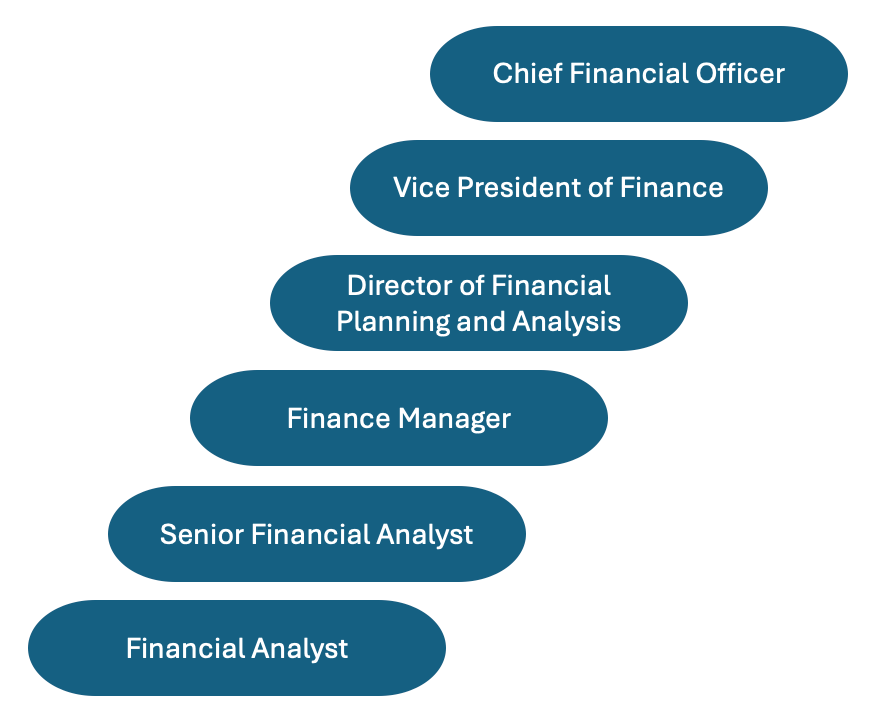
I thought my career would be a steady ascent, as swift and smooth as an escalator. After all, we are taught this is what success looks like and if we deviate, then we are failures.
In that first year at Microsoft, a moment that stuck with me was being in a “Lunch and Learn” with Microsoft’s then CFO, John Connors. I asked him if he had a path in mind when he started out and if his career largely followed that path. Maybe it was a naive question, but his response stuck with me. John said everyone thinks they have a path, and it’s often visualized in a straight line. Start at point A and get to point B. But in reality, you start at point A, and there is a bunch of chaos in the middle. Perhaps you still get to the endpoint you were hoping for, but you certainly don’t get there the way you envisioned.
He went on to say that a perfectly linear path can actually work against you. If you’re busy following step two on your carefully drawn career plan, and an unexpected opportunity appears, one that doesn’t fit the “next logical move,” you might ignore it. And that is how people miss the moments that could have changed everything.
Put another way, chaos (the unexpected, the nebulous, the nonlinear) allows you to build a career that isn’t limited to a rigid plan.
Here is how my career evolved over the last 20 years:
(Blue circle: School, Orange circle: Corporate roles, Green circle: Time away from corporate)
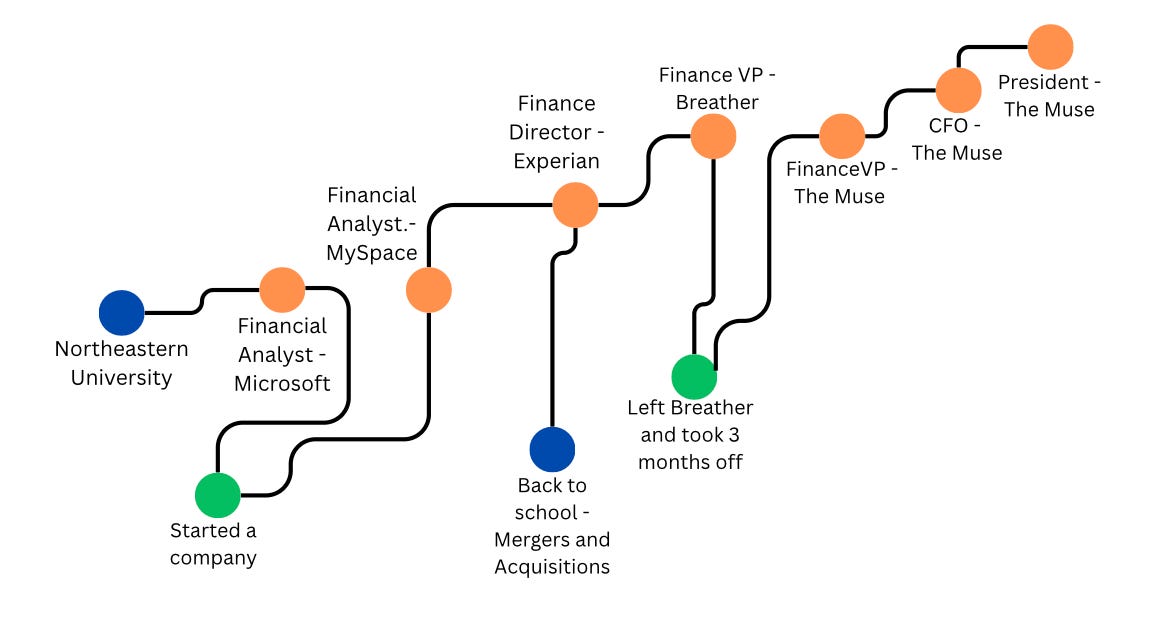
Mapping your career like this reveals patterns. You might begin to notice the junctures where chaos threw you off course, perhaps for the better in the long run. Here are three key observations I’ve noticed in my career’s trajectory:
- There’s a mix of linear progression, punctuated by periods of disruption and chaos. Your career can have both elements in it; you may notice this in your own career path
- The moments of uncertainty often contributed the most to my development, reshaping my thinking, expanding my skill set, and ultimately making me better prepared for what came next.
One of the most defining of those moments was my transition from big corporate to running Finance for a start-up (from Experian to Breather). To some I spoke with at the time, the move looked irrational. Why walk away from a well paid, secure role at a global company where I was moving through the ranks to join an unproven start up that was making less than $100k a month in revenue? The pivot ended up unlocking experiences, responsibilities and challenges that either never would have found me or I would have experienced them much later in life. - The periods that looked like stagnation (two orange circles on the same level) were periods of incubation. They were preparation — and almost always preceded a period of significant acceleration, when I reached a new title (Director to VP, VP to CFO)
The periods of chaos that I experienced in my career were always a precursor to meaningful growth and faster progression. It certainly didn’t seem like it at the time, as I sat in the dark and muddy trenches of uncertainty, when it felt like progress was invisible. These were the periods where I would grow into the person my next role required.
Principle for dealing with Chaos
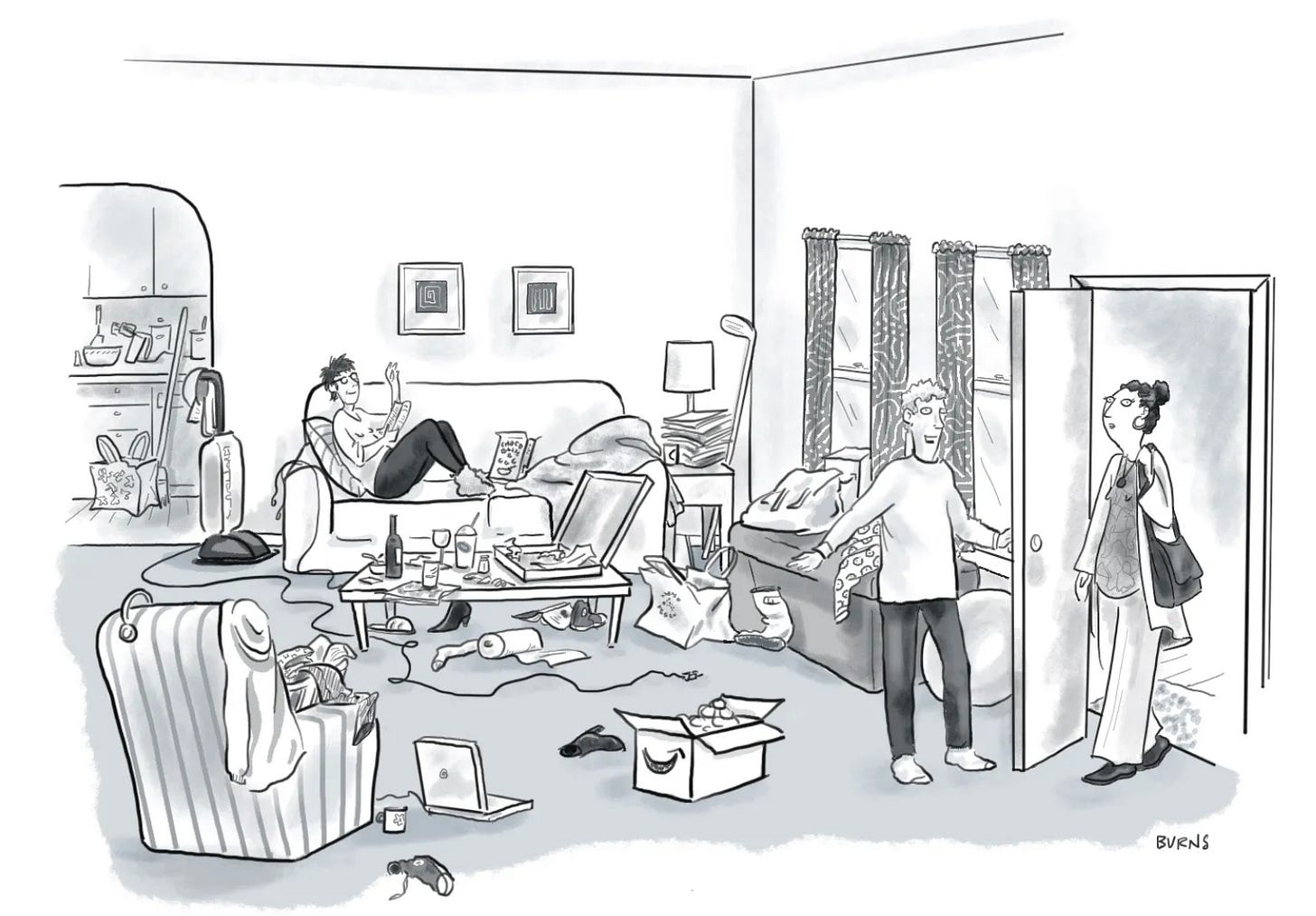
“Come on in, sorry about the mess - we’re just in the middle of not caring anymore”
Cartoon: Teresa Burns Parkhurst, New Yorker February 1, 2022
I can’t tell you the universal formula for managing chaos because it doesn’t exist. But I can tell you what has worked for me, and maybe it will work for you, too.
When chaos hits, we often want to think about and solve every problem it presents all at once. But this can be overwhelming and drain us of our time and energy, leading to a potentially terrible outcome. An alternative approach is to focus on the most immediately pressing issue. Break everything down into smaller, human-sized pieces.
Chaos feels impossible when it arrives as one big, tangled problem. It feels more bearable when it becomes a series of small, solvable ones. We don’t need to restore order to our entire world. We just need to find one clear next step and progress through it.
In March 2023, chaos struck: Silicon Valley Bank collapsed in the span of 48 hours. It was the largest bank failure since 2008, set off not by scandal or fraud, but by something more primal: panic. SVB had long been the bank of choice for the tech world, but as inflation rose and funding dried up, startups began drawing down their deposits. Confidence evaporated, withdrawals surged, and the bank unraveled almost in real time.
At the time, I was CFO of The Muse, and our primary operating account sat inside Silicon Valley Bank. I watched the news unfold in fragments, tweets, and articles; each update seemed worse than the last. Through the chaos came the questions: How would we pay employees? What vendors needed to be notified? Would our deposits be protected? And if they weren’t, then what?
My first instinct was to try and solve every problem immediately. But chaos punishes that impulse. So, we paused. We focused on the single most essential task: finding a new bank, fast. Otherwise, payroll would stall, vendors would wait, operations would freeze.
My CEO and I shifted into a state of controlled urgency. Through our network, we reached someone at JPMorganChase who was willing to move quickly. Over the next two days, including a weekend of scrambling, we worked through the paperwork, the logistics, and the approvals. By Monday morning, we had a functioning account and the means to operate again.
In these moments, we were forced to let go of our rigid plans to start paying attention to a new path, one that wasn’t designed.
So the next time chaos arrives, whether gently or with the force of a taxi, don’t just brace for impact. Notice what it might be asking of you and consider what it’s preparing you for.
Dave